WHY TAKEITDOWN.HELP EXISTS
The TAKE IT DOWN Act
America acted. We preserve the evidence.
On May 19, 2025, President Donald J. Trump signed the bipartisan TAKE IT DOWN Act into law.
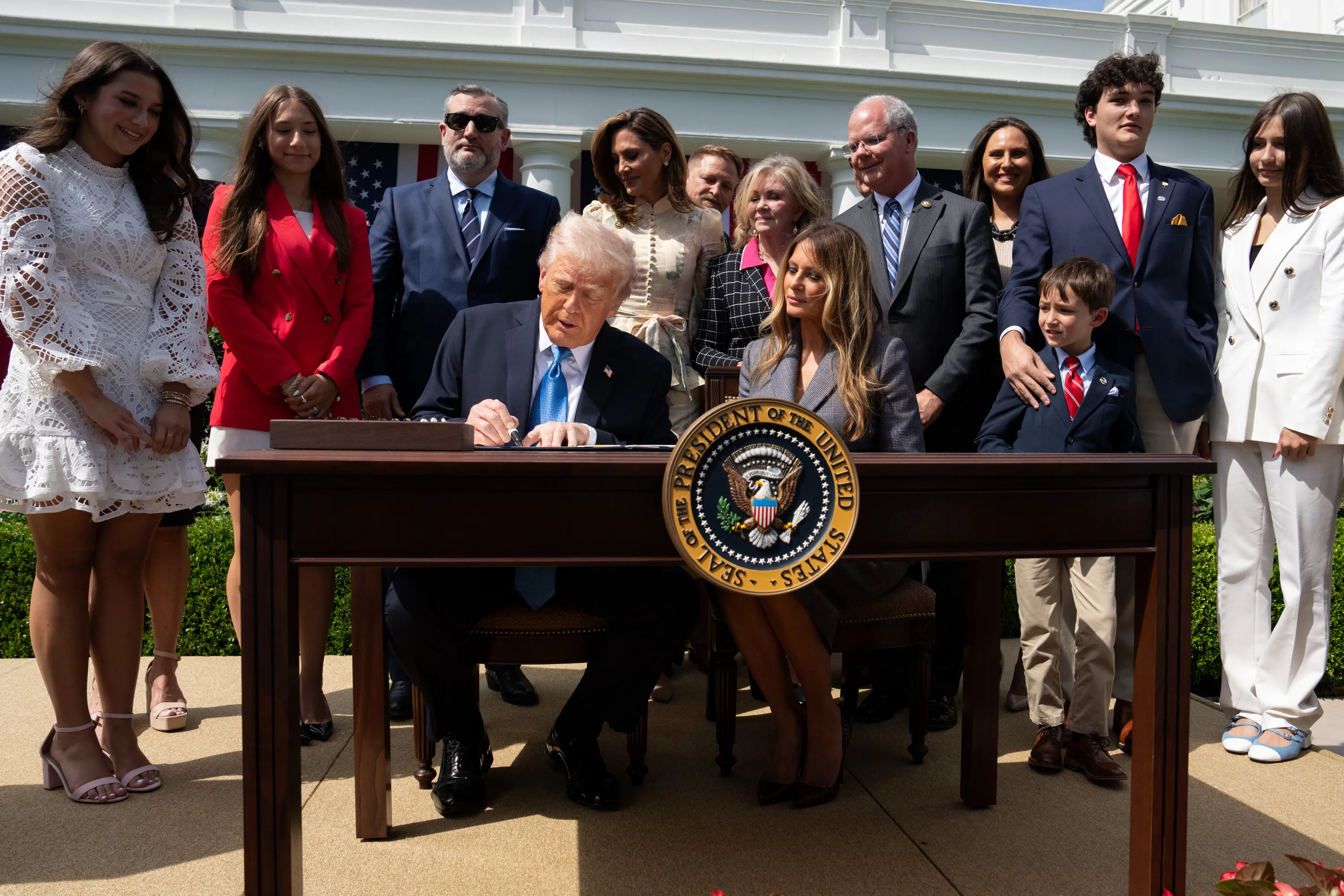
President Trump signs the TAKE IT DOWN Act into law, joined by First Lady Melania Trump, at the White House on May 19, 2025.
Sponsored in the Senate by Senator Ted Cruz and advanced with Senator Amy Klobuchar and a broad bipartisan coalition, the Act passed the Senate by unanimous consent and the House by 409–2, becoming Public Law 119-12. (Congress.gov)
America did not wait for AI-enabled intimate-image abuse to get worse. America acted. The law created powerful new federal protections against non-consensual intimate imagery, including AI-generated sexual deepfakes, and established a rapid process for victims to have qualifying material removed from covered platforms. (The White House)
TakeItDown.help was inspired by that achievement—and built around one practical question: “What happens to the evidence when removal works?”
When harmful content disappears, the source, surrounding context, URLs, account information and other material accessible to the victim may disappear with it. Remove the abuse. Preserve the evidence. TakeItDown.help is a free worldwide service for adults. Before removal, it preserves the victim-accessible source and context and creates one independently verifiable, victim-controlled evidence record. The victim decides whether that record is later shared with lawyers, police, prosecutors, authorities or courts. The goal is simple: remove the harm without losing the evidence.
What the law changed
A real removal remedy for a new form of abuse. The TAKE IT DOWN Act prohibits specified non-consensual publication of intimate visual depictions, including authentic imagery and digital forgeries, and requires covered platforms to provide a process through which victims can request removal. (Congress.gov)
Since May 19, 2026, Section 3 has been enforceable by the Federal Trade Commission. When a covered platform receives a valid request, qualifying material—together with known identical copies—must be removed within 48 hours. (Federal Trade Commission)
Forty-eight hours can stop enormous harm.
But speed makes preservation urgent.
A successful takedown may mean that material the victim could previously see is no longer available when a lawyer, investigator, prosecutor or court later needs to understand what happened. That is the gap TakeItDown.help is designed to address.
From American action to worldwide protection
The internet crosses borders. Evidence must travel with the victim. A victim may live in one country, the platform in another, and the hosting provider somewhere else entirely.
The legal rules may change from jurisdiction to jurisdiction. The need to preserve a reliable record does not.
TakeItDown.help takes the principle behind America’s rapid-removal response and makes evidence preservation available to adult victims worldwide.
One source. One preserved record. One victim in control of where it goes next.
Started in America. Protecting victims worldwide.
Independent by design
TakeItDown.help Foundation is an independent Delaware nonprofit corporation, recognized by the IRS as tax-exempt under section 501(c)(3) and classified as a public charity under section 170(b)(1)(A)(vi). It operates TakeItDown.help as a free worldwide service for adults.
TakeItDown.help is not NCMEC’s Take It Down service and is not affiliated with NCMEC, the Federal Trade Commission, the United States Government, or any Senator or congressional office.
NCMEC’s separate Take It Down service helps people remove or stop the sharing of nude, partially nude or sexually explicit images that were taken when they were under 18. (Take It Down)
The technology underlying TakeItDown.help was developed by Custodire AI Ltd, which donated a royalty-free licence to TakeItDown.help Foundation for operation of the service.
No federal funding, government integration or endorsement is required for TakeItDown.help to operate.
TakeItDown.help is operated by TakeItDown.help Foundation, an independent Delaware nonprofit corporation recognized by the IRS as a section 501(c)(3) public charity (EIN 38-4412286). It is not affiliated with NCMEC, the Federal Trade Commission, the United States Government, or any congressional office.